



Blogs
How Recruiters Can Find Their Next Client Using Hiring Signals
The Morning That Disappears
Every recruiter has lived this morning. You sit down with a list of companies to call. Maybe it came from LinkedIn, maybe your CRM, maybe someone built it six months ago and it’s been gathering dust in a spreadsheet. You start working through it.
Some of these companies aren’t hiring. Some are, but for roles you can’t support. Some have a 15-person internal TA team that would never bring in an agency. A few might actually need you, but you only figure that out after 45 minutes of bouncing between LinkedIn, job boards, company websites, Crunchbase, and whatever else you can dig up.
By the time you’ve done this properly for ten companies, your morning is gone. And honestly? The picture is still incomplete. You’re walking into calls half-prepared, asking questions you should already know the answers to. “Are you hiring?” “What roles are open?” “How big is your team?”
That’s a scavenger hunt. And it’s costing you deals.
Cold Outreach Still Works. Blind Outreach Doesn’t.
Consistent BD activity will always build pipeline. Calling, emailing, following up, staying visible. That part works. What makes or breaks the conversation is how much you know about the company before you pick up the phone.
Think about the difference between these two calls.
In the first one, you ring a Head of Talent and say,
“Hi, I’m calling from XYZ Recruitment, we specialise in tech hiring, wondered if you have any roles we could help with.”
Generic. Forgettable. They’ve heard it four times this week.
In the second one, you say,
“Hi, I noticed you’ve got five open engineering roles, a couple of which have been live for over two months. I also saw you’ve had some movement in your team recently, with a few people leaving for [Competitor X]. We work with companies facing exactly this kind of pressure and typically have relevant candidates moving within two weeks.”
Same prospect. But a completely different conversation. The second one works because it’s grounded in signals, real, observable clues about what’s happening inside a company. Agencies that have these signals win business. Agencies that don’t are left chasing it.
What Are Hiring Signals, Exactly?
Hiring signals are the breadcrumbs a company leaves behind when something is shifting in their workforce. Some are obvious. Open roles on a job board are the clearest sign that demand exists. The really valuable signals, though, are the ones that sit underneath the surface.
A company that keeps reposting the same role every few weeks? They’re stuck. Their internal process isn’t working and they’ve probably already burned through their LinkedIn Recruiter budget.
A company that grew 40% in the last year but has an average tenure of 1.3 years? That’s a revolving door. They’re hiring fast and losing people just as fast.
A new VP of Engineering who joined two months ago? They’re almost certainly about to restructure the team and bring in their own people.
It’s pattern recognition. And the recruiters who read these patterns early are the ones who show up with the right message at the right time, before the company has even spoken to another agency.
This Is What Wiggli Company Insights Was Built For
Wiggli Company Insights lives inside Wiggli Intelligence, the same tool you already use for candidate sourcing. The idea is simple: give recruiters the same depth of company intelligence for their BD desk that they expect for their sourcing desk.
Open a company profile and you immediately see the signals that matter: open roles, hiring momentum, talent flow, team composition, headcount growth, turnover rate, average tenure, hiring velocity, leadership changes, geographical distribution, and poachability indicators. All of it in one place. No more five-tab research sessions.
Company Insights helps you answer two questions that sit at the heart of every BD conversation: Is this company worth approaching? And, what should I say when I do?
Let’s walk through the signals that matter most, and how to use each one to start conversations that land.

Signal 1: Open Roles. The Front Door.
Open roles are the most obvious signal, and most recruiters stop there. Knowing a company has a job posted is table stakes. The real insight comes from the pattern behind the listing.
Is it a single backfill, or are there five roles in the same function? Has the listing been live for two weeks or two months? Has it been taken down and reposted? Are they hiring in one office or across three countries? A single open role might mean nothing. Five open sales roles means they’re building a team. An engineering role that’s been live for 60 days means the internal team is stuck, and that’s your opening.
Company Insights shows live open jobs with publish dates and role details, so you can read the story behind the listing before you ever reach out.
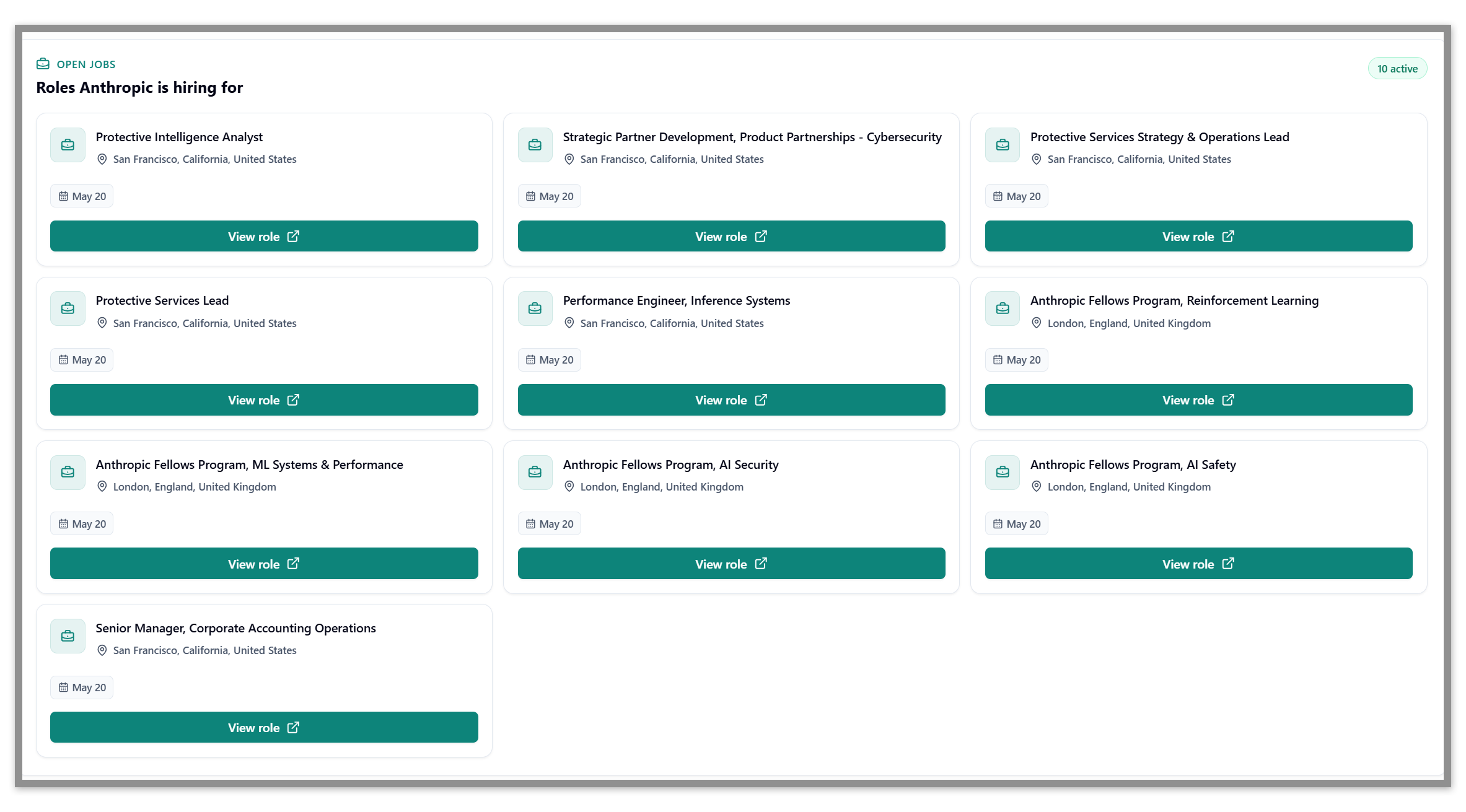
Example outreach: “Hi[Name], I noticed your Senior Backend Engineer role has been open for a while.That’s a tough profile in this market. We specialise in exactly this and may already have a few strong candidates. Worth a 10-minute call?”
Signal 2: Hiring Momentum. The Bigger Picture.
Open roles tell you what a company needs right now. Hiring momentum tells you the story of the last 12 months. And that story is often far more revealing.
A company might have three open jobs today, but if you zoom out and see they’ve hired 200 people in the past year while losing 80, you’re looking at a very different animal. That company is scaling aggressively. Their internal TA team is almost certainly under pressure. They need volume. They need speed. They probably need you.
Company Insights charts monthly hires against departures, so you can see at a glance whether a company is scaling up, quietly shrinking, or caught in a churn cycle where they’re replacing as fast as they’re hiring.

Example outreach: “Hi[Name], looks like your team has more than doubled this year, congrats on the growth. When things move that fast, hiring usually becomes the bottleneck. We work with scaling companies to take the sourcing pressure off for hard-to-fill roles. Open to a quick chat?”
Signal 3: High Turnover. The Silent Alarm.
High turnover is one of the most powerful signals in recruitment BD, and it works in two directions.
On the BD side, a company with high attrition needs to keep hiring just to maintain headcount. They probably need help finding people who actually stick around, people who fit the culture and the role, rather than candidates who accept an offer and leave six months later. That’s a value proposition most agencies can deliver on, especially if you screen for fit.
On the sourcing side, candidates at high-turnover companies tend to be more open to conversations. If people around them are leaving, they’re already thinking about their own options.
Company Insights surfaces turnover rate and average tenure side by side. A company with 12% turnover and an average tenure of 1.3 years is telling you something very different from one with 4% turnover and an average tenure of five years. The first one needs you. The second one might need you later.
Example outreach: “Hi[Name], I work with companies in [sector] and noticed there’s been quite a bit of movement in your team recently. We’ve been helping similar companies find people who stay and perform, which is the harder part of hiring. Happy to share how we approach retention-fit if that’s useful.”
Signal 4: Talent Flow. Follow the People.
Talent flow is one of the most underrated signals in recruitment, and it’s almost impossible to piece together manually. It shows you where a company’s new hires came from and where their leavers went.
Why does this matter? Because it reveals the competitive landscape in a way that no job board can. If a company is consistently losing engineers to two or three specific competitors, that’s a retention story you can bring straight to a BD conversation. If they’re hiring heavily from one particular company, that tells you where similar talent sits, which is gold for sourcing.
Instead of searching for candidates blindly, you can follow the actual movement of people. You’re no longer guessing where the talent is. You can see it.
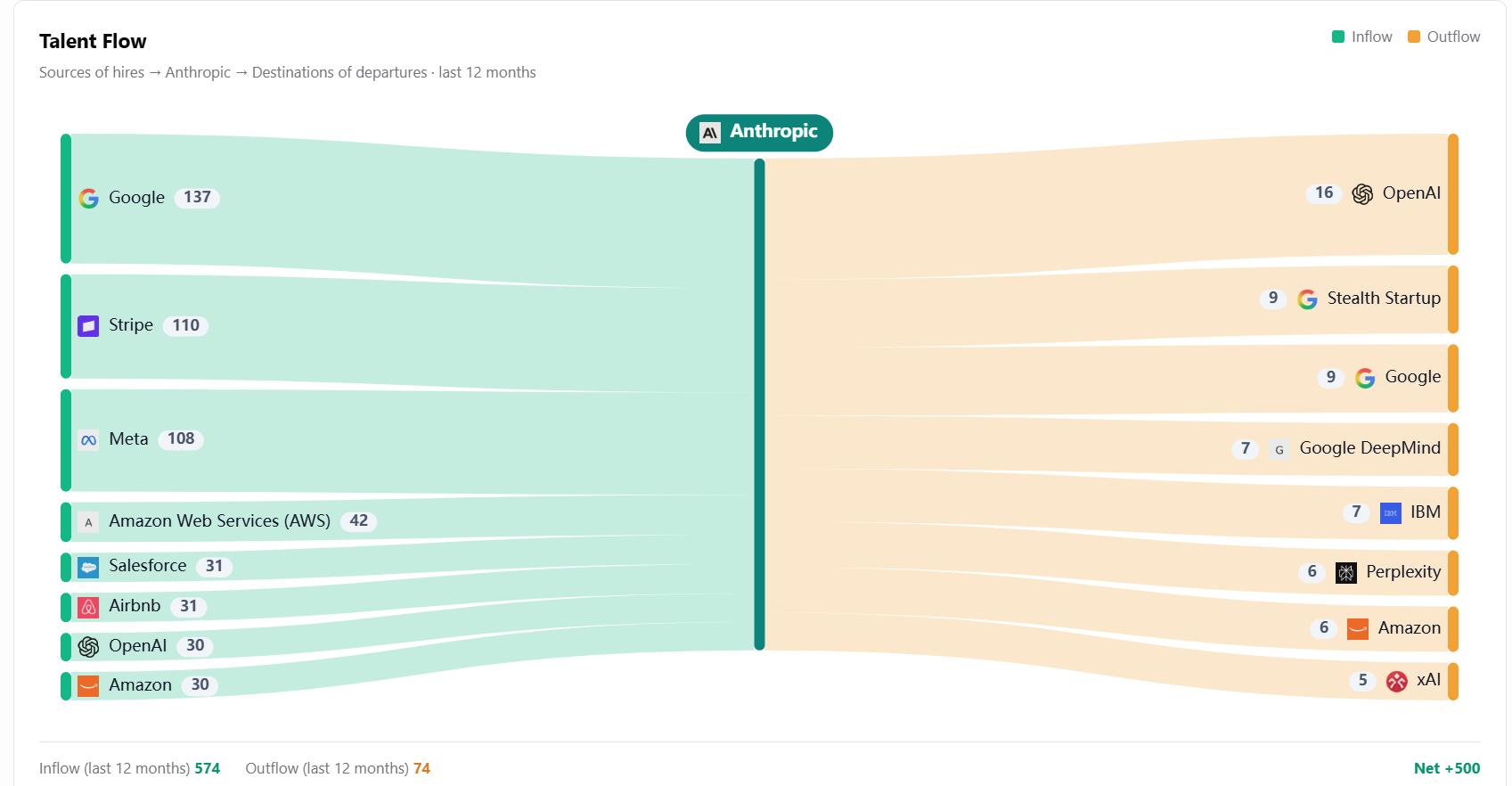
Example outreach: “Hi[Name], I noticed a few people from your team have recently moved to[Competitor X] and [Competitor Y]. That’s a pattern we’re seeing across the market. We help companies backfill these gaps quickly with candidates who aren’t always active on job boards.”
Signal 5: Team Composition. Know the Shape Before You Call.
Here’s a common agency mistake: you get on a call with a prospect and start asking basic questions about how their team is structured. How big is engineering? Where are your salespeople based? What seniority levels are you usually hiring at?
These are reasonable questions, but they’re first-date questions. And the prospect knows it. It signals that you haven’t done your homework.
Company Insights breaks down a company’s workforce by function, seniority, and location. So before you pick up the phone, you already know whether the company has a meaningful engineering team, whether their commercial org is growing, and whether they have people in the geographies you recruit for. You skip the basics and go straight to the conversation that matters.
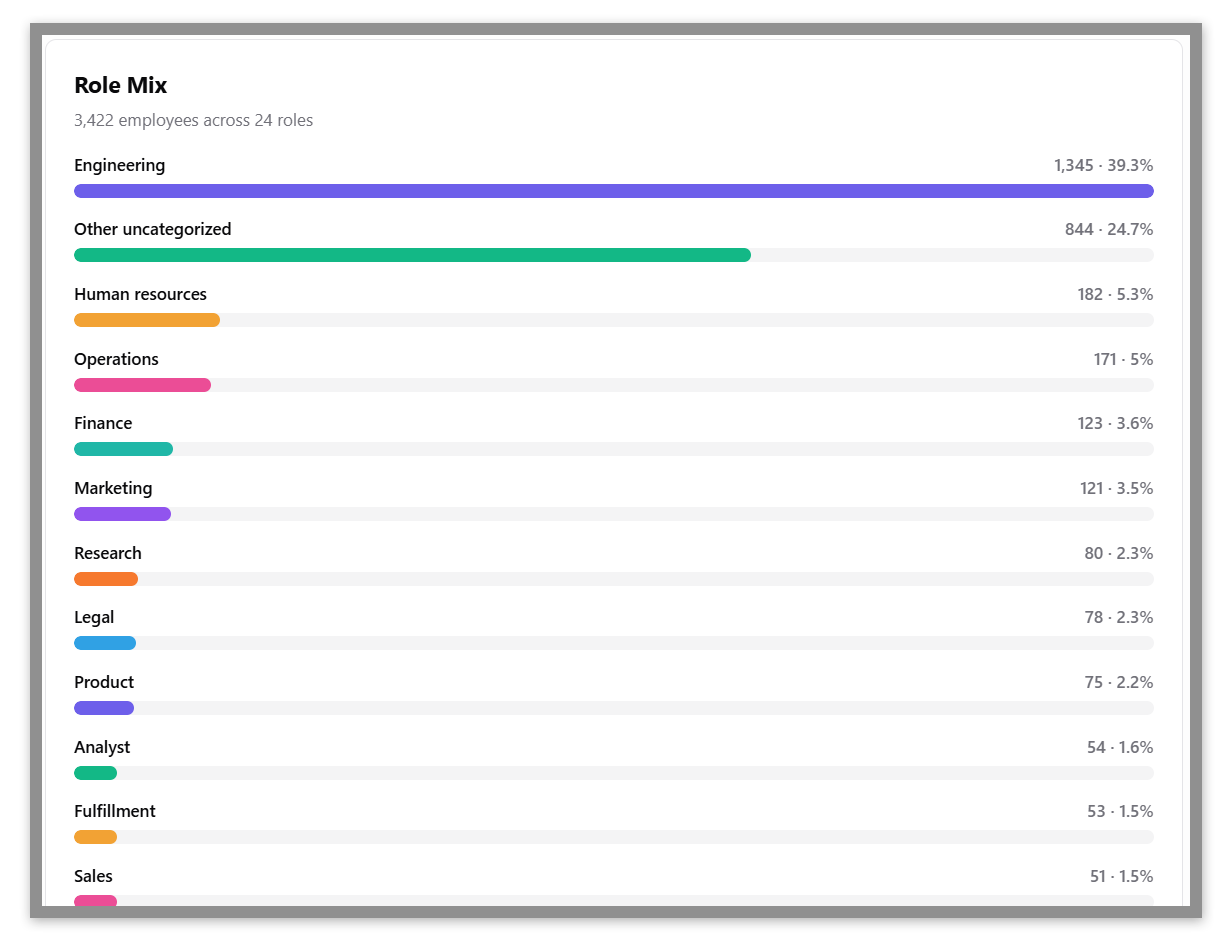
Signal 6: Geography. Where the Real Hiring Happens.
A company’s headquarters can be misleading. They might be based in London, but their engineering team is in Berlin, their sales team is in Amsterdam, and their ops team is spread across three time zones.
If you only look at HQ, you might write off a company that actually has a growing team in your exact market. Company Insights shows where a company’s people are actually based, so if you specialise in Benelux hiring and a company has a quietly expanding team in the Netherlands, you’ll see it.
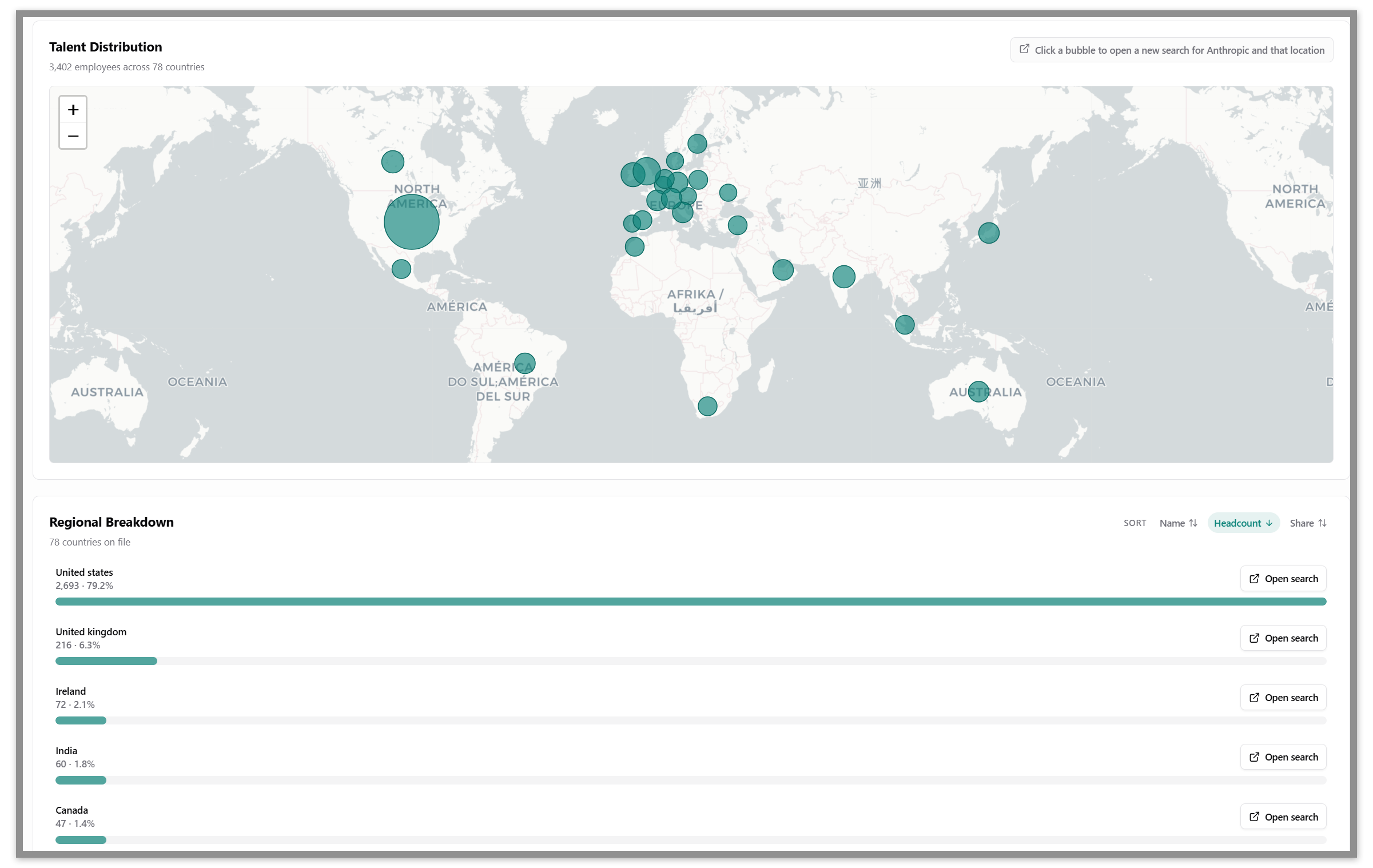
Signal 7: Leadership Changes. The 3-to-6-Month Window.
When a new leader joins, whether that’s a CTO, a VP of Sales, a Head of Talent, or a Country Manager, hiring priorities almost always shift. New leaders restructure teams. They bring in their own people. They create roles that didn’t exist before.
That creates a window. Typically three to six months of elevated hiring activity, and the agencies that reach out early in that window are the ones who get on the PSL.
Company Insights flags recent leadership movement, giving you a timely, relevant reason to reach out that feels natural.
Example outreach: “Hi [Name], saw you recently joined as VP Engineering, congrats on the move. New leaders usually mean new hires. If you’re looking to build out the team, we’ve got a strong network in [function/market] and can move fast. Worth connecting?”
Signal 8: Poachability. Where Candidates Are Ready to Move.
Poachability is a signal that sits at the intersection of BD and sourcing. It’s influenced by short tenure, high attrition, frequent movement, and general company instability.
For your sourcing desk, it helps you prioritise candidate outreach. Why spend three weeks nurturing a passive candidate at a company where nobody ever leaves, when you could be reaching out to equally qualified people at a company where movement is the norm?
For your BD desk, high poachability can also signal that the company is struggling to hold onto people, which means they’ll need to keep hiring. Either way, it’s a signal worth reading.
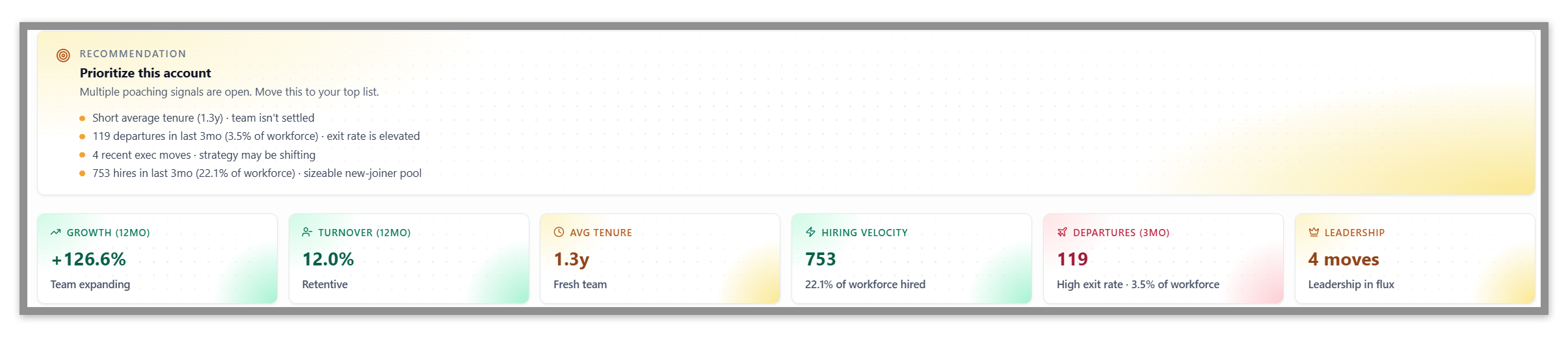
From Signal to Conversation: How This Works in Practice
Signals are only useful if you know what to do with them. Here’s how it plays out day to day.
Start by scanning for heat. Open Wiggli Company Insights and look for the companies that light up: multiple open roles, fast headcount growth, high turnover, short average tenure, recent leadership changes, or repeated hiring in the same function. These are the companies with the highest probability of needing external help.
Then prioritise ruthlessly. A company with one open role is worth tracking. A company with ten open roles, 126% growth, 12% turnover, and a new CTO is worth calling this afternoon. The data helps you separate the “watch list” from the “call now” list.
Lead with the signal in your outreach. Your first message should be anchored to something real.
“I noticed your team has grown 40% this year.” “I saw this role has been open for two months.” “I noticed you’ve had a few departures to [Competitor].”
These are simple openers, but they change the entire dynamic of the conversation because they show the prospect you’ve done your homework.
Then connect the signal to your value. If they have many open roles, you help with speed. If they have high turnover, you help with retention-fit. If they’re scaling fast, you support the internal TA team. If they’re losing talent to competitors, you help backfill critical gaps. If they have a new leader, you help build the new team.
That’s how hiring signals turn into BD conversations. And BD conversations turn into placements.
Your Next Client Is Already Showing the Signs
Recruitment BD has always been a timing game. The agencies that win are the ones who reach the right company before everyone else does, who spot a hiring need before it becomes obvious, who walk into conversations with context instead of questions.
Wiggli Company Insights gives you a faster, sharper way to do exactly that. Hiring activity, talent movement, growth signals, sourcing intelligence, all in one place, inside the same tool you already use every day.
Because your next client is probably already showing signs that they need help. You just need the right signals to see it.
Ready to find your next client using real hiring signals?
Explore Company Insights inside Wiggli Intelligence.
Book a demo of Wiggli Intelligence →
Partager cet article